
This study examines whether the quality of the regulatory environment affects the technical efficiency of banking systems in the Franc Zone, where two monetary unions (WAEMU and CEMAC) share a common currency arrangement and supranational banking supervision but differ in the quality of their national regulatory environments. Using a panel of the fifteen Franc Zone countries over 2000-2023, the technical efficiency of each national banking system is first estimated with an input-oriented Data Envelopment Analysis (DEA) model under variable returns to scale, and its determinants are then analysed with a fractional logit model with country fixed effects, suited to scores bounded between 0 and 1. Regulatory quality is measured by the World Bank's Worldwide Governance Indicators. Franc Zone banking systems operate on average at 68% of the best-practice frontier, which implies that the same outputs could be produced with about 32% fewer inputs. Regulatory quality has a positive average marginal effect on efficiency (0.125, p = 0.049), with diminishing returns: the effect is largest in countries with the weakest regulatory environments and fades as regulatory quality improves. This effect is moderate and loses significance in some robustness checks. Trade openness is associated with higher efficiency, whereas investment and human capital show weakly significant negative effects. The results suggest that improving the quality and credibility of the regulatory environment, rather than deregulation, can raise banking efficiency in the Franc Zone countries where regulation is weakest.
| Published in | Journal of Finance and Accounting (Volume 14, Issue 5) |
| DOI | 10.11648/j.jfa.20261405.12 |
| Page(s) | 226-237 |
| Creative Commons |
This is an Open Access article, distributed under the terms of the Creative Commons Attribution 4.0 International License (http://creativecommons.org/licenses/by/4.0/), which permits unrestricted use, distribution and reproduction in any medium or format, provided the original work is properly cited. |
| Copyright |
Copyright © The Author(s), 2026. Published by Science Publishing Group |
Banking Efficiency, Regulatory Quality, Data Envelopment Analysis, Franc Zone, Fractional Regression, Technical Efficiency
Variable | Definition | Source | Expected sign |
|---|---|---|---|
TE_VRS | Input-oriented DEA technical efficiency score of the national banking system, variable returns to scale, (0, 1] | Authors' computation (DEAP 2.1) | Dependent |
RQ | WGI Regulatory Quality estimate (approx. −2.5 to 2.5) | World Bank WGI | + / non-linear |
LogGDPpc | Logarithm of GDP per capita | World Bank WDI | + |
LogGFCF | Logarithm of gross fixed capital formation | World Bank WDI | +/− |
LogOPEN | Logarithm of trade openness ((exports + imports)/GDP) | World Bank WDI | + |
INF | Inflation, consumer prices (annual%) | World Bank WDI | − |
HC | Human capital indicator (education) | Authors' compilation | +/− |
SIZE | Average size of banks (total assets, billions of CFA francs) | BCEAO, BEAC | +/− |
Variable | Mean | Std. Dev. | Min | Max |
|---|---|---|---|---|
TE_VRS (Technical efficiency) | 0.6795 | 0.2963 | 0.0000 | 1.0000 |
RQ (Regulatory quality) | −0.8070 | 0.4169 | −1.6767 | −0.0478 |
LogGDPpc (log GDP per capita) | 3.4594 | 0.3871 | 2.9152 | 4.6154 |
LogGFCF (log gross fixed capital formation) | 1.2966 | 0.1869 | 0.6724 | 1.8915 |
LogOPEN (log trade openness) | 1.7895 | 0.1645 | 1.4824 | 2.1955 |
INF (Inflation,%) | 2.6168 | 4.0740 | −8.9747 | 31.5226 |
HC (Human capital) | 7.9982 | 7.4316 | 0.2694 | 40.5960 |
SIZE (Average bank size) | 3.2840 | 2.1485 | 0.1400 | 9.2900 |
Variable | VIF | 1/VIF |
|---|---|---|
LogGDPpc | 2.01 | 0.4983 |
LogOPEN | 1.97 | 0.5069 |
SIZE | 1.88 | 0.5320 |
RQ | 1.35 | 0.7398 |
LogGFCF | 1.25 | 0.8022 |
INF | 1.19 | 0.8371 |
HC | 1.01 | 0.9864 |
Mean VIF | 1.52 |
Variable | P (χ2) | p-val | Z (normal) | p-val | L* (logit) | p-val | Pm (χ2) | p-val | Integration |
|---|---|---|---|---|---|---|---|---|---|
TE_VRS | 28.11 | 0.458 | 0.107 | 0.543 | −0.073 | 0.529 | 0.015 | 0.494 | I (1) |
RQ | 94.14 | 0.000 | −4.635 | 0.000 | 5.821 | 0.000 | 8.280 | 0.000 | I (0) |
INF | 119.07 | 0.000 | −6.599 | 0.000 | 8.039 | 0.000 | 11.499 | 0.000 | I (0) |
LogGDPpc | 21.19 | 0.882 | 1.840 | 0.967 | −1.735 | 0.957 | −1.138 | 0.872 | I (1) |
LogGFCF | 41.27 | 0.083 | −1.285 | 0.099 | 1.365 | 0.088 | 1.455 | 0.073 | I (1) |
LogOPEN | 34.95 | 0.244 | −0.659 | 0.255 | 0.738 | 0.231 | 0.639 | 0.261 | I (1) |
HC | 56.00 | 0.003 | −1.055 | 0.146 | 1.901 | 0.031 | 3.356 | 0.000 | I (0) |
Variable | Coefficient | Std. Error | P > |z| |
|---|---|---|---|
RQ (Regulatory quality) | −0.457 | 1.006 | 0.650 |
RQ2 (Regulatory quality squared) | −0.675 | 0.592 | 0.254 |
LogGDPpc | −1.596 | 1.186 | 0.179 |
LogGFCF | −1.820 | 0.971 | 0.061* |
LogOPEN | 3.164 | 1.474 | 0.032** |
INF (Inflation) | 0.0001 | 0.019 | 0.998 |
HC (Human capital) | −0.021 | 0.012 | 0.075* |
Constant | 18.872 | 5.680 | 0.000*** |
Country fixed effects | Yes | ||
Turning point RQ* = −β1/(2β2) | −0.338 | 0.483 | 0.484 |
Joint test RQ = RQ2 = 0: χ2(2) | 3.86 | 0.145 | |
Observations (country-years) | 358 | ||
Countries (clusters) | 15 | ||
Pseudo-R2 | 0.2890 | ||
Log pseudolikelihood | −159.65 |
Variable | dy/dx (AME) | Std. Error | p-value | Direction |
|---|---|---|---|---|
RQ (combined linear + quadratic) | 0.1250 | 0.0635 | 0.049** | Positive, diminishing |
RQ effect at RQ = −1.6 | 0.2769 | 0.1675 | 0.098* | Positive |
RQ effect at RQ = −1.2 | 0.1872 | 0.1037 | 0.071* | Positive |
RQ effect at RQ = −0.8 | 0.0954 | 0.0589 | 0.105 | Not significant |
RQ effect at RQ = −0.4 | 0.0124 | 0.0881 | 0.888 | Not significant |
RQ effect at RQ = −0.1 | −0.0482 | 0.1370 | 0.725 | Not significant |
LogGDPpc | −0.2387 | 0.1770 | 0.178 | Not significant |
LogGFCF | −0.2723 | 0.1409 | 0.053* | Negative |
LogOPEN | 0.4733 | 0.2169 | 0.029** | Positive |
INF (Inflation) | 0.0000 | 0.0028 | 0.998 | Not significant |
HC (Human capital) | −0.0031 | 0.0018 | 0.073* | Negative |
(1) Baseline | (2) N = 360 | (3) + SIZE | (4) Linear RQ | (5) Probit | (6) No FE | |
|---|---|---|---|---|---|---|
AME of RQ | 0.1250** (0.0635) | 0.1270** (0.0627) | 0.1117 (0.0880) | 0.0959 (0.0620) | 0.1268** (0.0643) | 0.4548*** (0.0648) |
Joint test RQ, RQ2 (p) | 0.145 | 0.130 | 0.186 | — | 0.142 | 0.000 |
AME of LogOPEN | 0.4733** (0.2169) | 0.4677** (0.2158) | 0.4457** (0.2227) | 0.4950** (0.2461) | 0.4855** (0.2110) | 0.1590 (0.2752) |
AME of HC | −0.0031* (0.0018) | −0.0032* (0.0017) | −0.0034* (0.0018) | −0.0028 (0.0017) | −0.0035* (0.0018) | −0.0053** (0.0027) |
Country fixed effects | Yes | Yes | Yes | Yes | Yes | No |
Observations | 358 | 360 | 357 | 358 | 358 | 358 |
Pseudo-R2 | 0.289 | 0.291 | 0.288 | 0.288 | 0.290 | 0.156 |
AME | Average Marginal Effects |
BCEAO | Central Bank of West African States (Banque Centrale Des États De l'Afrique De l'Ouest) |
BEAC | Bank of Central African States (Banque Des États De l'Afrique Centrale) |
CEMAC | Central African Economic and Monetary Community |
COBAC | Central African Banking Commission |
DEA | Data Envelopment Analysis |
QMLE | Quasi-Maximum Likelihood Estimation |
RQ | Regulatory Quality |
TE_VRS | Technical Efficiency Under Variable Returns to Scale |
WAEMU | West African Economic and Monetary Union (WAEMU) |
VIF | Variance Inflation Factor |
WGI | Worldwide Governance Indicators |
WAMU | West African Monetary Union |
WDI | World Development Indicators |
| [1] | Berger, A. N., Humphrey, D. B. Efficiency of financial institutions: International survey and directions for future research. European Journal of Operational Research. 1997, 98(2), 175-212. |
| [2] | Berger, A. N., Mester, L. J. Inside the black box: What explains differences in the efficiencies of financial institutions? Journal of Banking & Finance. 1997, 21(7), 895-947. |
| [3] | Goddard, J., McKillop, D., Wilson, J. O. S. The diversification and financial performance of US credit unions. Journal of Banking & Finance. 2008, 32(9), 1836-1849. |
| [4] | Beck, T., Demirgüç-Kunt, A., Merrouche, O. Islamic vs. conventional banking: Business model, efficiency and stability. Journal of Banking & Finance. 2013, 37(2), 433-447. |
| [5] | Kumar, S., Gulati, R. Deregulation and Efficiency of Indian Banks. New Delhi: Springer; 2014. |
| [6] | Kablan, S. Banking Efficiency and Financial Development in Sub-Saharan Africa (IMF Working Paper No. 10/136). Washington, DC: International Monetary Fund; 2010. Available from: |
| [7] | Chen, M., Kang, Q., Wu, J., Jeon, B. N. Do macroprudential policies affect bank efficiency? Evidence from emerging economies. Journal of International Financial Markets, Institutions and Money. 2022, 77, 101529. |
| [8] | Lee, C.-C., Li, X., Yu, C.-H., Zhao, J. Does fintech innovation improve bank efficiency? Evidence from China's banking industry. International Review of Economics & Finance. 2021, 74, 468-483. |
| [9] | Le, T., Ngo, T., Ho, T. H., Do, T. T. M. Digitalisation and bank efficiency: Evidence from an emerging market. Asian Academy of Management Journal of Accounting and Finance. 2025, 21(2), 29-65. |
| [10] | BCEAO. Report on the Situation of the Banking System in the WAMU [in French: Rapport sur la situation du système bancaire dans l'UMOA]. Dakar: Central Bank of West African States; 2025. |
| [11] | BEAC. Annual Activity Report and Monetary Statistics of CEMAC [in French: Rapport annuel d'activité et statistiques monétaires de la CEMAC]. Yaoundé: Bank of Central African States; 2023. |
| [12] | Triki, T., Kouki, I., Dhaou, M. B., Calice, P. Bank regulation and efficiency: What works for Africa? Research in International Business and Finance. 2017, 39(Part A), 183-205. |
| [13] | Dewatripont, M., Tirole, J. The Prudential Regulation of Banks. Cambridge, MA: MIT Press; 1994. |
| [14] |
World Bank. Worldwide Governance Indicators: 2025 Revision. Available from:
https://www.worldbank.org/en/publication/worldwide-governance-indicators (accessed September 2026). |
| [15] | Demirgüç-Kunt, A., Detragiache, E. The determinants of banking crises in developing and developed countries. IMF Staff Papers. 1998, 45(1), 81-109. |
| [16] | Barth, J. R., Caprio, G., Jr., Levine, R. Bank regulation and supervision: What works best? Journal of Financial Intermediation. 2004, 13(2), 205-248. |
| [17] | Berger, A. N., Hasan, I., Zhou, M. Bank ownership and efficiency in China: What will happen in the world's largest nation? Journal of Banking & Finance. 2009, 33(1), 113-130. |
| [18] | Čihák, M., Tieman, A. Quality of Financial Sector Regulation and Supervision Around the World (IMF Working Paper No. 08/190). Washington, DC: International Monetary Fund; 2008. |
| [19] | Fries, S., Taci, A. Cost efficiency of banks in transition: Evidence from 289 banks in 15 post-communist countries. Journal of Banking & Finance. 2005, 29(1), 55-81. |
| [20] | Ben Naceur, S., Omran, M. The effects of bank regulations, competition, and financial reforms on banks' performance. Emerging Markets Review. 2011, 12(1), 1-20. |
| [21] | Pasiouras, F. International evidence on the impact of regulations and supervision on banks' technical efficiency: An application of two-stage data envelopment analysis. Review of Quantitative Finance and Accounting. 2008, 30(2), 187-223. |
| [22] | Kamarudin, F., Mohamad Anwar, N. A., Md. Nassir, A., Sufian, F., Tan, K. M., Iqbal Hussain, H. Does country governance and bank productivity nexus matter? Journal of Islamic Marketing. 2022. |
| [23] | Demirgüç-Kunt, A., Laeven, L., Levine, R. Regulations, market structure, institutions, and the cost of financial intermediation. Journal of Money, Credit and Banking. 2004, 36(3), 593-622. |
| [24] | Bonin, J. P., Hasan, I., Wachtel, P. Bank performance, efficiency and ownership in transition countries. Journal of Banking & Finance. 2005, 29(1), 31-53. |
| [25] | Thakor, A. V. Capital requirements, monetary policy, and aggregate bank lending: Theory and empirical evidence. Journal of Finance. 1996, 51(1), 279-324. |
| [26] | Barth, J. R., Lin, C., Ma, Y., Seade, J., Song, F. M. Do bank regulation, supervision and monitoring enhance or impede bank efficiency? Journal of Banking & Finance. 2013, 37(8), 2879-2892. |
| [27] | Chortareas, G. E., Girardone, C., Ventouri, A. Bank supervision, regulation, and efficiency: Evidence from the European Union. Journal of Financial Stability. 2012, 8(4), 292-302. |
| [28] | Fethi, M. D., Pasiouras, F. Assessing bank efficiency and performance with operational research and artificial intelligence techniques: A survey. European Journal of Operational Research. 2010, 204(2), 189-198. |
| [29] | Banker, R. D., Charnes, A., Cooper, W. W. Some models for estimating technical and scale inefficiencies in data envelopment analysis. Management Science. 1984, 30(9), 1078-1092. |
| [30] | Coelli, T. J. A Guide to DEAP Version 2.1: A Data Envelopment Analysis (Computer) Program (CEPA Working Paper No. 96/08). Armidale: Centre for Efficiency and Productivity Analysis, University of New England; 1996. |
| [31] |
Papke, L. E., Wooldridge, J. M. Econometric methods for fractional response variables with an application to 401(k) plan participation rates. Journal of Applied Econometrics. 1996, 11(6), 619-632.
https://doi.org/10.1002/(SICI)1099-1255(199611)11:6<619:AID-JAE418>3.0.CO;2-1 |
| [32] | Cameron, A. C., Gelbach, J. B., Miller, D. L. Bootstrap-based improvements for inference with clustered errors. Review of Economics and Statistics. 2008, 90(3), 414-427. |
| [33] | Kaufmann, D., Kraay, A., Mastruzzi, M. The Worldwide Governance Indicators: Methodology and analytical issues. Hague Journal on the Rule of Law. 2011, 3(2), 220-246. |
| [34] | Thomas, M. A. What do the Worldwide Governance Indicators measure? European Journal of Development Research. 2010, 22(1), 31-54. |
| [35] | Casu, B., Molyneux, P. A comparative study of efficiency in European banking. Applied Economics. 2003, 35(17), 1865-1876. |
APA Style
Endamane, A. R. M., Bita, C. A., Atirbi, H. C. (2026). Regulatory Quality and Banking Efficiency in Franc Zone Countries: An Analysis Based on the Data Envelopment Analysis Model. Journal of Finance and Accounting, 14(5), 226-237. https://doi.org/10.11648/j.jfa.20261405.12
ACS Style
Endamane, A. R. M.; Bita, C. A.; Atirbi, H. C. Regulatory Quality and Banking Efficiency in Franc Zone Countries: An Analysis Based on the Data Envelopment Analysis Model. J. Finance Account. 2026, 14(5), 226-237. doi: 10.11648/j.jfa.20261405.12
@article{10.11648/j.jfa.20261405.12,
  author = {Aime Rodrigue Moatsa Endamane and Charles Alain Bita and Hamidou Cephas Atirbi},
  title = {Regulatory Quality and Banking Efficiency in Franc Zone Countries: An Analysis Based on the Data Envelopment Analysis Model},
  journal = {Journal of Finance and Accounting},
  volume = {14},
  number = {5},
  pages = {226-237},
  doi = {10.11648/j.jfa.20261405.12},
  url = {https://doi.org/10.11648/j.jfa.20261405.12},
  eprint = {https://article.sciencepublishinggroup.com/pdf/10.11648.j.jfa.20261405.12},
  abstract = {This study examines whether the quality of the regulatory environment affects the technical efficiency of banking systems in the Franc Zone, where two monetary unions (WAEMU and CEMAC) share a common currency arrangement and supranational banking supervision but differ in the quality of their national regulatory environments. Using a panel of the fifteen Franc Zone countries over 2000-2023, the technical efficiency of each national banking system is first estimated with an input-oriented Data Envelopment Analysis (DEA) model under variable returns to scale, and its determinants are then analysed with a fractional logit model with country fixed effects, suited to scores bounded between 0 and 1. Regulatory quality is measured by the World Bank's Worldwide Governance Indicators. Franc Zone banking systems operate on average at 68% of the best-practice frontier, which implies that the same outputs could be produced with about 32% fewer inputs. Regulatory quality has a positive average marginal effect on efficiency (0.125, p = 0.049), with diminishing returns: the effect is largest in countries with the weakest regulatory environments and fades as regulatory quality improves. This effect is moderate and loses significance in some robustness checks. Trade openness is associated with higher efficiency, whereas investment and human capital show weakly significant negative effects. The results suggest that improving the quality and credibility of the regulatory environment, rather than deregulation, can raise banking efficiency in the Franc Zone countries where regulation is weakest.},
 year = {2026}
}
TY  - JOUR
T1  - Regulatory Quality and Banking Efficiency in Franc Zone Countries: An Analysis Based on the Data Envelopment Analysis Model
AU  - Aime Rodrigue Moatsa Endamane
AU  - Charles Alain Bita
AU  - Hamidou Cephas Atirbi
Y1  - 2026/11/11
PY  - 2026
N1  - https://doi.org/10.11648/j.jfa.20261405.12
DO  - 10.11648/j.jfa.20261405.12
T2  - Journal of Finance and Accounting
JF  - Journal of Finance and Accounting
JO  - Journal of Finance and Accounting
SP  - 226
EP  - 237
PB  - Science Publishing Group
SN  - 2330-7323
UR  - https://doi.org/10.11648/j.jfa.20261405.12
AB  - This study examines whether the quality of the regulatory environment affects the technical efficiency of banking systems in the Franc Zone, where two monetary unions (WAEMU and CEMAC) share a common currency arrangement and supranational banking supervision but differ in the quality of their national regulatory environments. Using a panel of the fifteen Franc Zone countries over 2000-2023, the technical efficiency of each national banking system is first estimated with an input-oriented Data Envelopment Analysis (DEA) model under variable returns to scale, and its determinants are then analysed with a fractional logit model with country fixed effects, suited to scores bounded between 0 and 1. Regulatory quality is measured by the World Bank's Worldwide Governance Indicators. Franc Zone banking systems operate on average at 68% of the best-practice frontier, which implies that the same outputs could be produced with about 32% fewer inputs. Regulatory quality has a positive average marginal effect on efficiency (0.125, p = 0.049), with diminishing returns: the effect is largest in countries with the weakest regulatory environments and fades as regulatory quality improves. This effect is moderate and loses significance in some robustness checks. Trade openness is associated with higher efficiency, whereas investment and human capital show weakly significant negative effects. The results suggest that improving the quality and credibility of the regulatory environment, rather than deregulation, can raise banking efficiency in the Franc Zone countries where regulation is weakest.
VL  - 14
IS  - 5
ER  -


Faculty of Economics and Management Sciences, University of Ngaoundere, Ngaoundere, Cameroon
Biography: Hamidou Cephas Atirbi holds a PhD in Economics from the University of Ngaoundere, Cameroon (2026), where his thesis examined the effect of mayors' human capital on municipal budgetary performance. He is a data scientist and the founder and CEO of AtiRbi, a data analytics firm based in Ngaoundere that supports universities, NGOs and municipalities. His research covers applied econometrics, public economics, banking performance and digital economics.

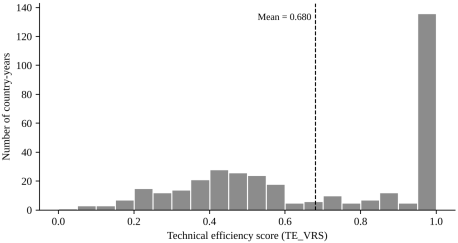
Figure 1. Distribution of technical efficiency scores (TE_VRS), 358 country-year observations. Source: Authors' calculations.
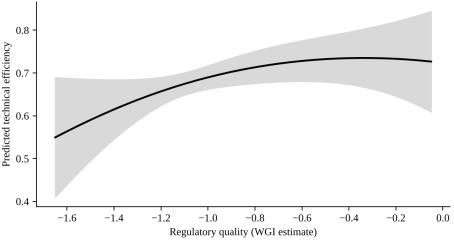
Figure 2. Predicted technical efficiency across the observed range of regulatory quality, with 95% confidence interval (other covariates at their observed values). Source: Authors' calculations based on Table 5.

Information



 Share This Article
 Twitter
 Linked In
 Facebook

 Copy
 Download